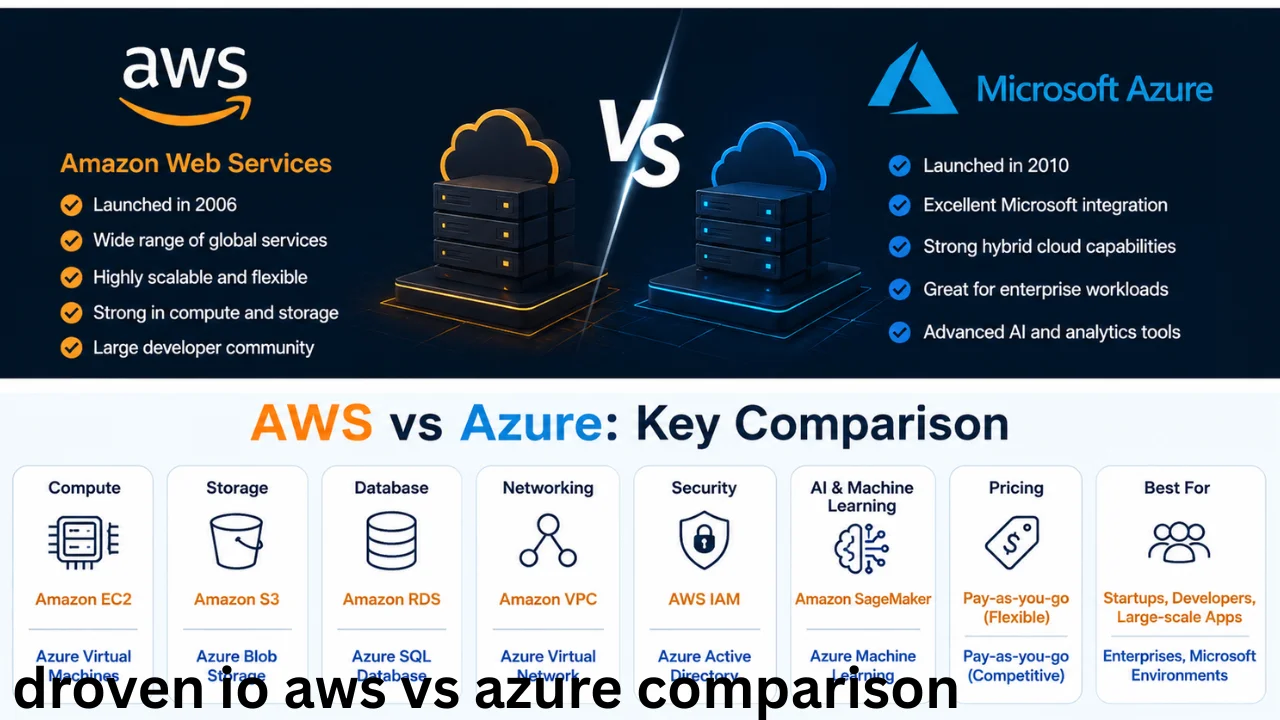
Droven Io Aws vs Azure Comparison: Complete Guide for 2026
Cloud computing has become the backbone of modern businesses. When companies choose a cloud platform, they often compare Amazon Web Services (AWS) and Microsoft Azure. Recently, many people have searched for Droven IO AWS vs Azure Comparison to understand how these platforms differ and which one fits different business needs. This guide explains the major differences, strengths, pricing, security, AI services, and use cases in simple language.
Whether you are a business owner, developer, IT manager, or student, this article will help you make a better decision.
You May Like: when was the game innerlifthunt released
What Is Droven IO AWS vs Azure Comparison?
The term Droven IO AWS vs Azure Comparison refers to a detailed evaluation of two of the world’s largest cloud computing platforms:
- Amazon Web Services (AWS)
- Microsoft Azure
The comparison usually covers:
- Cloud services
- Pricing
- Storage
- Virtual machines
- Security
- Artificial Intelligence (AI)
- Machine Learning (ML)
- Database services
- Networking
- Scalability
- Enterprise support
The goal is to help organizations choose the platform that best matches their technical and business requirements.
Why Businesses Compare AWS and Azure
Today, companies rely on cloud platforms to host websites, manage applications, store files, analyze data, and develop AI solutions.
Businesses compare these platforms because they want:
- Lower operating costs
- Better performance
- High availability
- Strong security
- Easy management
- Global infrastructure
- Reliable customer support
AWS and Azure both provide these services, but each has unique strengths.
Droven IO AWS vs Azure Comparison: Quick Overview
| Feature | AWS | Azure |
|---|---|---|
| Launch Year | 2006 | 2010 |
| Parent Company | Amazon | Microsoft |
| Global Reach | Very Large | Very Large |
| Data Centers | Hundreds worldwide | Hundreds worldwide |
| Main Users | Startups and Enterprises | Enterprises and Microsoft users |
| Hybrid Cloud | Good | Excellent |
| AI Services | Advanced | Advanced |
| Pricing | Flexible | Flexible |
| Windows Integration | Good | Excellent |
| Linux Support | Excellent | Excellent |
Cloud Infrastructure Comparison
Infrastructure is one of the biggest factors when choosing a cloud provider.
AWS has one of the largest cloud infrastructures in the world. It offers many availability zones and regions across different countries.
Azure has expanded rapidly and now provides similar worldwide coverage. It performs especially well for organizations already using Microsoft products.
Both platforms offer:
- Virtual servers
- Object storage
- Networking
- Load balancing
- Databases
- Backup services
AWS has slightly more mature infrastructure, while Azure focuses heavily on enterprise integration.
Droven IO AWS vs Azure Comparison for Pricing
Pricing is one of the most important factors for businesses.
AWS follows a pay-as-you-go pricing model. Users only pay for the resources they consume.
Azure also uses pay-as-you-go pricing but provides extra discounts for organizations already using Microsoft software licenses.
AWS Pricing Benefits
- Flexible billing
- Reserved Instances
- Savings Plans
- Spot Instances
- Free Tier for beginners
Azure Pricing Benefits
- Azure Hybrid Benefit
- Reserved Virtual Machines
- Enterprise discounts
- Pay-as-you-go model
- Free account credits
Pricing depends on:
- CPU usage
- Memory
- Storage
- Network traffic
- Database usage
Small businesses should estimate their workloads before selecting either platform.
Compute Services Comparison
Virtual machines are the heart of cloud computing.
AWS offers Amazon EC2, one of the most powerful virtual machine services.
Azure provides Azure Virtual Machines with excellent Windows Server integration.
AWS Strengths
- Large instance selection
- High customization
- Excellent Linux support
- Broad global availability
Azure Strengths
- Better Windows support
- Easier Active Directory integration
- Simple enterprise management
Both platforms can scale resources automatically when demand increases.
Storage Services
Cloud storage keeps business data secure and accessible.
AWS storage options include:
- Amazon S3
- Elastic Block Store
- Glacier
- Elastic File System
Azure storage options include:
- Blob Storage
- Disk Storage
- Azure Files
- Archive Storage
Both provide:
- Data backup
- Encryption
- High availability
- Disaster recovery
- Object storage
AWS S3 remains one of the industry’s most trusted storage services.
Database Services
Modern applications require reliable databases.
AWS offers:
- Amazon RDS
- Aurora
- DynamoDB
- Redshift
Azure provides:
- Azure SQL Database
- Cosmos DB
- PostgreSQL
- MySQL
- SQL Managed Instance
AWS provides greater database variety, while Azure simplifies Microsoft SQL deployments.
Networking Features
Networking connects applications across the cloud.
AWS networking includes:
- Virtual Private Cloud (VPC)
- Route 53
- Elastic Load Balancer
- CloudFront CDN
Azure networking includes:
- Virtual Network
- Azure DNS
- Load Balancer
- Front Door
- ExpressRoute
Both offer secure networking for businesses of every size.
Security Comparison
Security is a major concern for cloud users.
AWS includes:
- Identity and Access Management (IAM)
- Encryption
- Firewall services
- Security Hub
- GuardDuty
Azure includes:
- Microsoft Defender for Cloud
- Azure Active Directory
- Key Vault
- Security Center
- Sentinel
Both providers follow international security standards.
Features include:
- Multi-factor authentication
- Data encryption
- Identity management
- Compliance certifications
- Threat detection
Neither platform is considered weak in security.
Artificial Intelligence and Machine Learning
AI services continue to grow every year.
AWS provides:
- SageMaker
- Rekognition
- Comprehend
- Lex
- Polly
Azure provides:
- Azure AI Studio
- Azure Machine Learning
- Cognitive Services
- OpenAI integration
- Bot Services
Businesses developing AI applications can succeed with either platform.
Azure has become popular among organizations using Microsoft AI tools.
Hybrid Cloud Support
Many companies still use on-premises servers.
Hybrid cloud allows businesses to connect local infrastructure with cloud services.
AWS offers:
- Outposts
- Storage Gateway
- Direct Connect
Azure offers:
- Azure Arc
- Azure Stack
- ExpressRoute
Azure is generally considered stronger for hybrid cloud environments.
Developer Tools
Developers need tools for coding, testing, and deployment.
AWS provides:
- CodeCommit
- CodeBuild
- CodeDeploy
- CodePipeline
Azure offers:
- Azure DevOps
- GitHub integration
- Visual Studio support
Developers already working with Microsoft technologies often prefer Azure.
Performance Comparison
Performance depends on:
- Server location
- Application design
- Resource allocation
- Network quality
AWS generally offers slightly faster deployment options because of its larger infrastructure.
Azure performs exceptionally well for Windows-based enterprise applications.
Both platforms provide:
- High uptime
- Auto scaling
- Load balancing
- Global content delivery
Customer Support
Good customer support helps businesses solve problems quickly.
AWS offers:
- Documentation
- Community forums
- Developer support
- Business support
- Enterprise support
Azure provides:
- Microsoft documentation
- Technical support
- Enterprise plans
- Developer support
- Learning resources
Both maintain large knowledge bases and active communities.
Business Use Cases
AWS Is Best For
- Startups
- Large cloud-native applications
- Linux workloads
- Big data projects
- Global web applications
- High-performance computing
Azure Is Best For
- Microsoft environments
- Enterprise companies
- Windows Server
- Office 365 integration
- Active Directory
- Hybrid cloud
Advantages of AWS
- Largest cloud ecosystem
- Wide service selection
- Excellent scalability
- Strong developer community
- Mature infrastructure
- Reliable global network
Advantages of Azure
- Excellent Microsoft integration
- Strong hybrid cloud
- Enterprise-friendly
- Easy Windows migration
- Competitive pricing
- Powerful AI ecosystem
AWS Limitations
- Pricing can become complex.
- Some services require advanced knowledge.
- Cost management needs careful monitoring.
Azure Limitations
- Some services have a learning curve.
- Documentation can vary between products.
- Smaller third-party ecosystem compared to AWS.
Droven IO AWS vs Azure Comparison for Small Businesses
Small businesses often focus on affordability and simplicity.
AWS offers flexible pricing with many startup-friendly services.
Azure becomes attractive for companies already using Microsoft 365, Windows Server, or Active Directory.
A careful cost estimate should always be completed before deployment.
Droven IO AWS vs Azure Comparison for Enterprises
Large organizations usually require:
- Compliance
- Security
- Global deployment
- Disaster recovery
- Identity management
AWS serves many multinational companies because of its broad service portfolio.
Azure is equally popular among enterprises that depend heavily on Microsoft technologies.
Which Platform Should You Choose?
The answer depends on your business goals.
Choose AWS if you need:
- Maximum flexibility
- Larger cloud ecosystem
- Advanced developer services
- Broad Linux support
- Large-scale cloud-native applications
Choose Azure if you need:
- Microsoft integration
- Hybrid cloud
- Enterprise identity management
- Windows Server compatibility
- Microsoft software licensing benefits
There is no single winner for every organization.
Future of Cloud Computing
Cloud computing continues to grow rapidly.
Future improvements will include:
- More AI services
- Better automation
- Stronger cybersecurity
- Faster networking
- Lower cloud costs
- Improved sustainability
AWS and Azure continue investing billions of dollars into new technologies every year.
Businesses can expect even more advanced cloud capabilities in the coming years.
Frequently Asked Question
1. What is Droven IO AWS vs Azure Comparison?
Droven IO AWS vs Azure Comparison is a detailed comparison of Amazon Web Services and Microsoft Azure. It helps businesses understand their features, pricing, performance, and cloud services.
2. Which is better, AWS or Azure?
The better platform depends on your business needs and existing technology. AWS is popular for flexibility, while Azure works well with Microsoft products.
3. Is AWS cheaper than Azure?
Both platforms use pay-as-you-go pricing, so costs vary based on usage. Azure may save money for Microsoft users, while AWS offers several cost-saving plans.
4. Which platform offers better security?
AWS and Azure both provide strong security features like encryption, identity management, and compliance tools. Both are trusted by businesses around the world.
5. Who should use AWS and who should use Azure?
AWS is ideal for startups, developers, and large cloud applications. Azure is a great choice for businesses using Microsoft software and hybrid cloud environments.
Conclusion
Choosing between AWS and Azure depends on your business size, technical needs, existing software, and future plans. AWS remains a leader in cloud innovation with its broad range of services and global infrastructure. Azure stands out with strong Microsoft integration, enterprise tools, and excellent hybrid cloud capabilities. Instead of asking which platform is universally better, focus on which one matches your workload and long-term goals. This Droven IO AWS vs Azure Comparison shows that both platforms are powerful, secure, and capable of supporting everything from small websites to large enterprise systems. By understanding their differences, you can confidently choose the cloud platform that delivers the best value for your organization.
People Also Read: when was the game innerlifthunt released